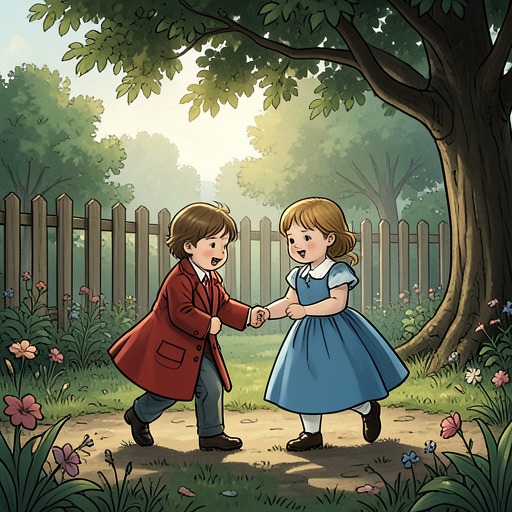
Yewarra family circle
The Girl he Never NoticedThe Yewarra family circle is the chosen family that gradually takes shape around Cameron Hillier’s estate. It brings together Cameron, his adopted nephew Archie, Liz Montrose, and Liz’s daughter Scout, while also depending on the practical care of Mary Montrose and the household staff. Its decisive significance is that it answers several forms of absence at once: Archie is orphaned, Scout grows up with a single mother and a dead grandfather, Liz needs security for her child, and Cameron recognizes that wealth and professional power have not given him a settled family life. Yewarra becomes a family not because its members begin with uncomplicated biological unity, but because they repeatedly choose to protect, understand, and remain with one another.## Formation from Separate HouseholdsThe circle begins with two existing but vulnerable family arrangements. Liz Montrose is raising Scout as a single mother, with Mary Montrose sharing their home and caring for Scout while Liz works. Liz describes Scout as nearly four and as a “living doll,” and the warmth in her voice reveals that motherhood is not merely an obligation in her life but a source of emotional vitality. At the same time, Mary’s presence makes Liz’s household workable, although Liz acknowledges that her mother can be eccentric and sometimes needs care herself. Their arrangement is affectionate and functional, but it is also a form of continual negotiation in which three generations depend on one another.The other central unit is Cameron Hillier and Archie. Archie is Cameron’s sister Amelia Hillier’s orphaned son, and Cameron has adopted him. The adoption gives Archie a legal and domestic parent in place of the parents he has lost, but the emotional situation remains more complicated. Amelia had been abandoned by Archie’s unknown father and was never the same afterward; she died without revealing the father’s identity, leaving Archie both motherless and fatherless. Cameron therefore understands Archie’s vulnerability through the history of his sister, while also confronting the limits of his own availability as a businessman.## Yewarra as a Domestic SettingYewarra initially appears as Cameron’s private, highly controlled domain rather than as a family home. Liz approaches the estate feeling that she might escape from Cameron, his car, and the property, as though she were entering a zone over which she had no control. Yet the estate quickly exerts a different force. The drive through majestic trees, white and blue agapanthus, flowering jasmine and honeysuckle, jacarandas, gardenias, and roses enchants her, and the abundance of colour and perfume makes the place seem capable of becoming more than an employer’s residence. The setting’s beauty marks the first movement from intimidation toward belonging.The house also contains a nursery wing designed around children’s needs. Its playroom has large cut-outs from Peter Pan and Alice in Wonderland, many toys, a kitchenette, and three bedrooms. The space makes visible the possibility of accommodating children as a permanent part of domestic life, not as guests temporarily fitted around adult priorities. Even the helicopter pad and Cameron’s demanding business schedule exist beside this child-centered infrastructure. Yewarra thus holds two competing versions of Cameron’s life: the logistical machinery of wealth and work, and the domestic world in which children require time, safety, and emotional continuity.## Cameron’s Deliberate Expansion of the FamilyCameron offers Liz a position connected to Yewarra partly because he needs the estate’s work to function more humanely. He wants to free the stud master and the people working with the horses from paperwork and from the constant stream of visitors. The job comes with a staff cottage large enough for Liz, Scout, and Mary, and with Archie as a ready-made companion for Scout. Cameron’s proposal therefore joins employment, accommodation, childcare, and companionship in a single structure. It is not simply a promotion: it is an attempt to reorganize several lives around a shared place.He is explicit about the emotional reason behind the offer. Cameron knows something about single mothers because Amelia was one, and that history gives him sympathy for Liz. More importantly, he believes Liz could provide the influence Archie needs during the last year before school. He wants that year to be memorable, safe, and happy, while admitting that he cannot spend as much time with Archie as he should and expects school to create still more distance between them. His judgment is based on what he has observed: Liz’s care for Scout illuminates her whenever she speaks about her daughter, and her interaction with Archie persuades him that she could bring the same steadiness to the boy. The chosen family is consequently founded through a practical offer, but the offer is shaped by an ethical concern for children’s security.## The Children at the CenterArchie and Scout become the emotional hinge of the Yewarra family circle. Cameron observes that they have much in common: both are articulate for their ages, and both are accustomed to receiving substantial adult attention as single children. Liz considers Archie especially bright and sensitive. Cameron, in turn, notices that Archie seems more relaxed after Liz and Scout join the household, although he remains watchful about the boy’s safety and asks Daisy to monitor the problem of Archie being shoved around.Archie’s sensitivity gives the new household a particular moral pressure. He is distressed when five of Wenonah’s six puppies are sent to new homes; he eats little during the day and cannot sleep that night. His attachment to animals is matched by his attachment to Cameron, whom he hero-worships. Cameron tries to compensate for the limited time he can spend with Archie by sending postcards, books, and unusual objects from different parts of Australia and overseas. Archie displays these gifts proudly in a special cabinet, although one full-size boomerang caused him to break a window when he experimented with it indoors. Cameron then found him the song “My Boomerang Won't Come Back,” turning a frightening mishap into something Archie could laugh about. Care in this family is therefore expressed through supervision, imaginative gifts, and the effort to meet a child’s emotional needs after mistakes.Scout and Archie’s bond confirms that the family circle is not limited to Cameron and Liz’s romance. They become companions within the estate, and the arrangement gives Scout a friend while giving Archie daily access to another child who understands the unusual intimacy of being the center of adult attention. The household’s promise is made concrete through their shared routines and through the way adults interpret their behavior: the children’s relationship is evidence that Yewarra is becoming a lived community rather than merely a convenient arrangement.## Tensions over Belonging and PermanenceCameron’s relationship to the circle is conflicted because he is the person who imagines it but also the person most likely to stand outside it. He recognizes that his parents’ hard work helped him build a huge fortune, yet he feels that his life lacks what they had. His business career and pursuit of greater power have become a treadmill, even a strait-jacket, and he wonders whether the absence of a permanent partner or proper family has shaped that obsession. He also sees the destructive consequences of love through Amelia’s abandonment and through the women who pursue him for his money. Against this background, the idea of creating a family with Liz, Scout, and Archie becomes both an aspiration and a threat to his habitual control.Cameron eventually realizes that the family circle has already been formed without him. After keeping his distance from Liz for a month, partly to let her settle and partly because he promised to respect a boundary between them, he discovers that Liz, Scout, and Archie have forged a genuine unit. He feels like an outsider in his own home. The reversal is crucial: the estate he intended to use as the setting for a family experiment has generated a family whose emotional bonds no longer depend on his constant direction. Yewarra’s domestic life has acquired its own center, and Cameron must decide whether to join it honestly rather than merely arrange it for his convenience.When he proposes a more permanent solution, Cameron frames it in terms of mutual stability. He tells Liz that he needs a mother for Archie, while she needs a father for Scout and a settled background, and he presents Yewarra as an exceptionally solid one. He also insists that Liz herself has settled into the estate and its life as though she had been born to it. The language exposes the risk within the chosen family: marriage could be treated as a rational consolidation of childcare, security, and home. Yet the proposal also acknowledges that Liz’s presence has already become indispensable to the household, and that Cameron wants not only a serviceable arrangement but the woman who has changed the meaning of his home.## Recognition and Enduring MembershipThe circle receives its strongest confirmation when Liz and Scout return to Yewarra after an absence. Mrs Preston and Daisy greet them with tears, Bob and his wife wait at the helipad, and even Hamish, the head gardener, is present. The welcome extends beyond the romantic couple and demonstrates that Yewarra’s family circle includes employees whose loyalties have become personal. Their collective response shows that Liz and Scout have not merely occupied a cottage or performed a job; they have become part of the estate’s social and emotional order.Archie gives the most direct expression of what their absence has meant. He hugs Cameron, then Scout, but pauses before Liz and asks whether she will leave again and whether she will take Scout away, because nothing feels the same when they are gone. Liz kneels and embraces both children, promising that they will not go away again. Archie accepts the reassurance and immediately turns to Scout with news that Golly and Ginny have had more offspring, inviting her to see them; the children then race together toward the menagerie. The moment resolves the family circle through action rather than declaration. Liz’s promise, Archie’s restored confidence, Scout’s immediate inclusion, and the household’s tearful welcome make permanence a shared emotional fact.The Yewarra family circle consequently redefines family as a structure of chosen and performed belonging. Adoption links Cameron and Archie; motherhood links Liz and Scout; Mary provides intergenerational care; employment brings Liz into the estate; and daily affection allows the children to become companions. The circle remains marked by loss, work, and unequal power, but its final shape depends on continuity: people stay, children feel safe, and a house once governed by Cameron’s ambitions becomes a place in which several lives can recognize one another as home.